
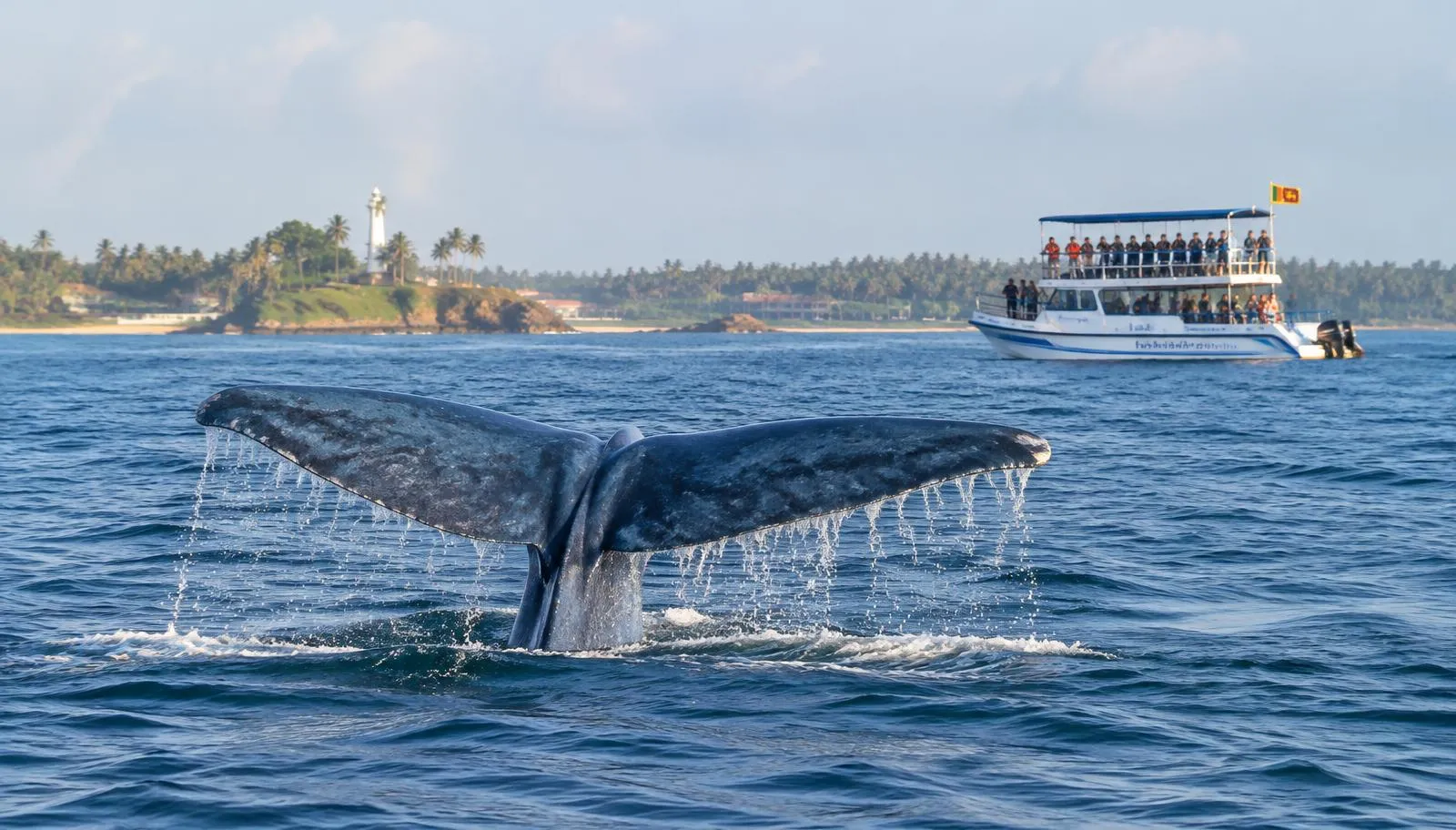
Mirissa Whale Watching
Join a morning marine adventure off the coast of Mirissa to view blue whales and dolphins in their natural habitat. Ashi Travels provides comfortable, dedicated private transport from your hotel along with personalized trip coordination via WhatsApp.
About this activity
Overview of Whale Watching in Mirissa
Mirissa is a vibrant coastal enclave on the southern tip of Sri Lanka, recognized globally as one of the premier locations on the planet for viewing cetaceans in their wild, open-ocean environment. The primary draw is the chance to witness the magnificent blue whale (Balaenoptera musculus), the largest animal ever known to have lived on Earth. In addition to blue whales, the waters off Mirissa are frequented by sperm whales, Bryde's whales, short-finned pilot whales, and multiple dolphin species, notably massive schools of spinner dolphins that ride the ocean swells.
What sets Mirissa apart from almost every other marine reserve in the world is its unique bathymetry. Just a few nautical miles south of Dondra Head and Mirissa, the oceanic continental shelf drops off steeply into abyssal depths exceeding a thousand meters. This dramatic underwater cliff generates powerful upwelling currents that carry nutrient-rich deep water to the sunlit surface. These nutrients nourish vast populations of plankton and krill, which in turn attract large baleen whales and apex oceanic predators. Consequently, visitors do not need to embark on multi-day oceanic voyages to reach deep-sea feeding grounds; the open-sea realm of the blue whale is accessible within a morning boat excursion from the harbor.
Ashi Travels acts as your personal ground transport and logistics partner for this extraordinary expedition. We provide private, air-conditioned vehicles driven by professional local chauffeurs who specialize in punctual, safe, and comfortable journeys. Rather than worrying about pre-dawn taxi negotiations, navigating congested coastal roads in the dark, or arranging return transport while damp and tired after a sea voyage, our guests enjoy seamless door-to-door service. You can discuss your schedule, vehicle preferences, and harbor transfer requirements directly with our team via WhatsApp.
Why Mirissa is One of the World's Premier Whale Watching Hubs
Marine scientists and eco-travelers alike consider the southern rim of Sri Lanka one of the most reliable regions anywhere on the globe to observe resident and migratory baleen whales. For decades, international oceanographers documented a persistent corridor of marine mammals navigating the busy maritime shipping lanes south of Dondra Point. In recent years, local seafaring communities in Mirissa transitioned their maritime skills from offshore fishing to passenger eco-cruises, transforming the humble fishing town into an international epicenter for marine observation.
Several geographical and biological factors make Mirissa an unmatched vantage point:
- Extreme Proximity to Deep Waters: In many whale watching capitals, boats must steam 20 to 40 nautical miles offshore before finding sufficient water depth. In Mirissa, the drop-off occurs within 6 to 12 nautical miles from the harbor mouth, minimizing transit time and maximizing observation time.
- Residential and Migratory Populations: While many blue whales migrate through the northern Indian Ocean following monsoon wind patterns, scientific research indicates that a distinct northern Indian Ocean population of pygmy blue whales remains in these warm tropical waters throughout the year, sustaining high sighting probabilities during the principal season.
- Remarkable Species Diversity: It is not unusual for a single morning excursion to encounter not only blue whales, but also pods of hundreds of acrobatic spinner dolphins, playful bottlenose dolphins, striped dolphins, sea turtles, flying fish, and occasionally killer whales (orcas) or majestic sperm whales.
- Sheltered Natural Harbor: Mirissa Harbour provides a secure, well-protected embarkation point where passenger vessels can safely moor and load travelers without battling breaking surf on the beach.
Geographic Setting and Ocean Dynamics
The southern coastline of Sri Lanka functions as a giant geographical wedge extending into the Indian Ocean. Mirissa lies nestled between Weligama Bay to the west and the town of Matara to the east. Directly south of Mirissa, there is no major landmass between the island and the frozen continent of Antarctica thousands of kilometers away. This uninterrupted expanse of open water allows long-period Southern Ocean swells to travel unimpeded toward the Sri Lankan shelf.
The bathymetric contour known as the Dondra Canyon acts as an underwater highway. Deep-water currents hitting this submerged canyon are deflected upward, causing massive vertical circulation. In the tropical sun, this upwelling creates blooms of microscopic phytoplankton. Tiny marine crustaceans known as krill feed on this plankton, forming immense swarms. A full-grown blue whale requires up to four tons of krill every single day, and the underwater topography off Mirissa serves as a reliable banquet table. When conditions are calm, these giant mammals can be observed gracefully surfacing, exhaling immense vertical columns of vaporized breath, and arching their broad backs before slipping beneath the surface with an iconic tail fluke display.
Where It Is and How to Get There
Mirissa is located in the Matara District within Sri Lanka's Southern Province. Access to Mirissa has improved dramatically with the expansion of the Southern Expressway (E01), connecting the capital, the international airport, and the interior hill country to the southern coast via high-speed arterial toll roads.
Ashi Travels provides private door-to-door vehicle transport from any location in Sri Lanka directly to Mirissa Harbour. Below are approximate travel times when traveling in our comfortable, private air-conditioned vehicles:
- From Colombo City: Approximately 2 to 2.5 hours via the Southern Expressway (E01), exiting at the Weligama or Kokmaduwa interchange.
- From Bandaranaike International Airport (CMB), Katunayake: Approximately 2.5 to 3 hours via the Airport Expressway and Southern Expressway. Many travelers arriving late at night or early morning choose our private airport transfer to travel straight to their Mirissa hotel in time for morning activities.
- From Galle Fort and Unawatuna: Approximately 45 minutes to 1 hour along the scenic coastal road (A2) or around 35 minutes via the expressway interchange.
- From Bentota, Beruwala, and Ahungalla: Approximately 1 hour and 15 minutes to 1.5 hours via the E01 expressway.
- From Tangalle and Hiriketiya: Approximately 45 minutes to 1 hour westward along the coastal road or internal express routes.
- From Kandy and the Central Highlands: Approximately 4.5 to 5.5 hours, descending from the central mountains toward the southern plains via modern multi-lane expressways.
- From Ella: Approximately 3.5 to 4.5 hours descending through Wellawaya and the southern plains past Udawalawe.
Traveling by private vehicle is especially critical for whale watching in Mirissa because departures from the harbor are scheduled between 06:00 AM and 06:45 AM. Public trains and regional buses do not run early enough to deliver passengers directly to the passenger piers from outlying coastal hubs like Galle, Bentota, or Tangalle. Ashi Travels ensures you arrive relaxed and on time without having to navigate dark roads on two wheels or haggle with roadside transport.
Best Time for Whale Watching in Sri Lanka
Whale watching in Sri Lanka is strictly dictated by the island's dual monsoon climate. The Indian Ocean around Sri Lanka experiences two distinct monsoon seasons: the Southwest (Yala) monsoon and the Northeast (Maha) monsoon. These weather cycles dramatically alter wind speeds, sea swell height, and surface visibility.
The Prime Season in Mirissa: November through April The premier window for whale watching off Mirissa spans from November to April, peaking between December and March. During these months, the Southwest Monsoon recedes, leaving the southern ocean generally calm, with light morning breezes and minimal surface chop. Sea conditions during this window allow passenger vessels to cruise comfortably offshore without excessive roll or pitch. Water clarity is high, and blue whales congregate reliably in the feeding zones south of Mirissa and Dondra.
- November to December: The transition period brings calmer waters, and sightings begin to climb sharply as whales establish their feeding patterns.
- January to March: Typically represents the absolute peak in calm seas, clear blue skies, and high sighting frequencies. Pods of dolphins are also exceptionally active during these calm months.
- April: Marking the tail end of the peak season, April offers exceptionally warm waters and glassy morning conditions, though sporadic afternoon convection rain showers may appear.
The Off-Peak and Monsoon Season: May through October From May through October, the Southwest Monsoon sweeps across the southern and western regions of Sri Lanka. While whales remain present in the ocean, strong offshore winds, heavy swells, and rough sea states make navigating small and medium passenger boats challenging and uncomfortable. Many operators suspend or reduce departures during these months due to passenger comfort and maritime safety regulations.
Alternate Destinations in the Off-Season One of the unique advantages of Sri Lanka is that when one coastline experiences a monsoon, the opposite coastline enjoys dry, tranquil weather. If you are visiting Sri Lanka between June and October, the eastern port town of Trincomalee becomes the premier hub for whale and dolphin watching. Ashi Travels can seamlessly adjust your private vehicle tour itinerary to take you to Trincomalee on the East Coast or Kalpitiya on the North West Coast, where calm waters prevail during the southern off-season. You can confirm current conditions and seasonal recommendations with us at any time via WhatsApp.
What to Expect Step by Step
Knowing what happens throughout your whale watching expedition helps ensure a stress-free, rewarding adventure. Here is how a typical morning unfolds when arranged with Ashi Travels:
Step 1: Early Morning Chauffeur Pickup Depending on your hotel location, your Ashi Travels chauffeur arrives between 05:00 AM and 05:45 AM. Vehicles are impeccably clean, fully air-conditioned, and equipped with comfortable seating, allowing you to relax or finish an early morning coffee during the drive. If your hotel prepares a breakfast packet, your driver will help you stow it safely.
Step 2: Harbor Check-In and Safety Verification Upon reaching Mirissa Fisheries Harbour, your chauffeur guides you to the passenger pier area. The harbor is alive with activity as fishing crafts return and passenger boats prepare lines. Ashi Travels helps connect you with the licensed boat crew. All certified passenger boats carry mandatory personal flotation devices (life jackets) for every passenger on board. It is compulsory to wear your life jacket before the vessel pulls away from the pier.
Step 3: Cruising Past the Harbor Breakwater Between 06:30 AM and 07:00 AM, the vessel slips its moorings and navigates through the sheltered harbor basin out past the protective stone breakwater. The ocean swell immediately becomes apparent as the vessel points south into the open Indian Ocean. Watching the sunrise illuminate the coconut groves and headlands along the coast is a memorable highlight of the outbound cruise.
Step 4: The Deep Sea Search The boat heads south, motoring for approximately 45 to 90 minutes across the continental shelf. The crew continually scans the horizon 360 degrees. Experienced spotters look for specific telltale signs: a sudden plume of white vapor rising six to nine meters above the sea surface (the whale blow), flashes of white water caused by leaping spinner dolphins, circling flocks of pelagic terns feeding on baitfish, or large oily slicks on the water surface known as slick footprints left behind when a whale dives.
Step 5: The Encounter When a whale is spotted, the captain adjusts course, reducing throttle to approach carefully and ethically. If it is a blue whale, you will first see the expansive, mottled grayish-blue back breaking the surface, rolling smoothly across the water for several seconds. Because blue whales are so immense, their dorsal fin appears tiny and is positioned far back on the body. After taking several deep breaths, the whale will often raise its tail flukes skyward before executing a deep feeding dive that can last between eight and twenty minutes.
Between whale sightings, boats frequently cross paths with massive schools of spinner dolphins. These agile mammals often bow-ride the pressure wave created by the boat, leaping high into the air and executing multiple lateral spins before splashing back into the deep blue water.
Step 6: The Return Leg and Chauffeur Welcome After spending adequate time on the viewing grounds, the vessel turns north and cruises back toward Mirissa. Total time spent on the water typically ranges between three and five hours, depending on how far offshore the animals were found that morning. Around mid-day or late morning, you will step back onto the stable harbor pier, where your Ashi Travels driver will be waiting to greet you with a cool vehicle, ready to drive you back to your hotel for a shower and lunch or onward to the next coastal attraction.
Marine Species Encountered off Mirissa
The oceanic ecosystem of the southern Sri Lankan shelf supports a complex food chain. During your cruise, you may encounter a wide range of marine fauna:
- Blue Whale (Balaenoptera musculus): The undisputed sovereign of the ocean. Blue whales can grow up to 30 meters in length and weigh upwards of 150 metric tons. Their heart alone can weigh as much as an automobile. Seeing the massive blow and expansive flank of a blue whale in the wild is a humbling experience.
- Sperm Whale (Physeter macrocephalus): The largest of the toothed predators, famous for diving into dark oceanic trenches to hunt giant squid. Sperm whales are recognizable by their distinct, blunt square head and an asymmetrical blowhole that expels water vapor forward and to the left.
- Bryde's Whale (Balaenoptera edeni): A sleek, warm-water baleen whale that feeds extensively on schooling fish and krill in coastal and offshore waters. They feature distinctive parallel ridges on the top of their head.
- Short-finned Pilot Whale: Highly social toothed whales that travel in tight matriarchal family pods, often resting quietly at the surface in calm weather.
- Spinner Dolphin (Stenella longirostris): Known for spectacular acrobatic displays, spinner dolphins frequent Mirissa in pods ranging from a dozen to several hundred individuals.
- Bottlenose Dolphin (Tursiops): Robust, curious, and intelligent dolphins frequently spotted cruising the shallower reef edges and nearshore waters.
- Pelagic Birds and Flying Fish: Skimming across the water surface, schools of flying fish frequently take flight to escape predators, while oceanic petrels, shearwaters, and crested terns hover overhead.
Who It Suits and Important Safety Considerations
Whale watching in Mirissa is an unforgettable adventure suitable for a wide variety of travelers, but it is an open-ocean journey that requires preparation and realistic expectations.
Families and Children Children often find the experience exhilarating, especially when energetic dolphin pods surround the boat. However, parents should bear in mind that boats remain at sea for several hours without immediate access to shore. Children should be comfortable wearing life jackets for the entire duration and must be supervised closely around railings.
Travelers Prone to Motion Sickness Even on calm mornings during the peak season, the Indian Ocean experiences long, rolling swells. The motion of a vessel rolling in open ocean swells can trigger severe motion sickness in sensitive travelers. If you are prone to motion sickness, taking an over-the-counter motion sickness medication the night before and again 30 to 60 minutes before departure is highly recommended. Sitting near the center of gravity on the lower deck, keeping your eyes on the distant horizon, and avoiding confined enclosed cabins will significantly reduce nausea.
Senior Travelers and Those with Mobility Concerns Embarking and disembarking at the harbor requires stepping across a narrow gangway between the harbor pier and the boat deck, which moves with the tide and wash. Travelers with significant mobility impairments should evaluate this before booking. Ashi Travels chauffeurs assist you to the boarding point and ensure harbor staff lend a steady hand during boarding.
General Maritime Safety Sri Lankan maritime authorities enforce passenger vessel safety guidelines in Mirissa Harbour. Always choose operators that supply certified life jackets, carry functional radio equipment, and do not overload passenger decks. When Ashi Travels helps arrange your tour, we coordinate with established harbor operators adhering to legal safety guidelines.
What to Wear and What to Bring
Preparing thoughtfully for a morning in the tropical open sea ensures comfort and prevents sunburn, dehydration, and camera mishaps.
- Lightweight, Breathable Clothing: Wear loose-fitting cotton or quick-drying synthetic clothing. A light long-sleeve shirt protects your arms from intense tropical UV rays reflecting off the ocean.
- Flat, Non-Slip Footwear: Boat decks can become wet and slick from ocean spray. Avoid high heels, stiff dress shoes, or slick flip-flops; choose rubber-soled sandals, deck shoes, or sneakers.
- Wide-Brimmed Hat and Polarized Sunglasses: The glare from tropical seawater can cause intense eye strain. Polarized sunglasses cut through surface glare, helping you spot whales swimming just below the waterline.
- High-SPF Mineral Sunscreen: Sun reflection on open water accelerates sunburn. Apply waterproof, reef-safe sunscreen before boarding and reapply as needed.
- Motion Sickness Remedy: Keep preventative seasickness tablets, ginger candies, or acupressure wristbands accessible.
- Camera Equipment with Zoom Capability: To capture detailed photographs of whales surfacing dozens of meters away, a telephoto lens (such as 70-200mm or 100-400mm) is ideal. Ensure you bring a secure neck strap, lens cloth to remove salt spray, and a waterproof dry bag to shield electronics.
- Reusable Water Bottle and Light Snacks: Staying hydrated is critical. Many passenger boats provide light fruit snacks or biscuits, but having your personal water supply is always recommended.
Responsible and Ethical Marine Tourism
As whale watching popularity grew in Mirissa over the past two decades, awareness surrounding cetacean conservation and ethical boat operations expanded. Unregulated boat traffic, excessive engine noise, and reckless high-speed approaches can cause substantial stress to feeding mothers and calves, alter natural migration lanes, and risk propeller strikes.
Sri Lanka's Department of Wildlife Conservation (DWC) has established marine regulations designed to protect marine mammals:
- Safe Distance Maintenance: Vessels should maintain an ethical buffer of at least 100 meters from whales, slowing their approach gradually rather than charging directly into the animal's path.
- Parallel Approach: Boats should cruise parallel to the whale's direction of travel rather than cutting across its bow or boxing the animal in with multiple vessels.
- Engine Deceleration: Engines should be shifted to neutral or low idle when near cetaceans to minimize acoustic disruption beneath the surface.
- Zero Harassment: Chasing diving animals, attempting to touch them, or deploying unauthorized commercial swimmers/divers into their immediate path is strictly prohibited.
- Waste Management: Nothing must ever be thrown overboard. Plastic waste represents one of the greatest perils to marine wildlife globally.
By engaging with responsible transport and boat partners, travelers help reinforce ethical wildlife viewing standards. Ashi Travels actively advocates for ethical viewing practices, encouraging guests to patronize boat operators that prioritize animal welfare over aggressive close encounters.
Combining Whale Watching with Nearby South Coast Sights
A whale watching cruise in Mirissa usually finishes around mid-day, leaving your afternoon completely open to explore the rich cultural and natural landscape of Sri Lanka's South Coast. Because your Ashi Travels chauffeur and dedicated vehicle remain at your disposal throughout the day, you can effortlessly combine your ocean excursion with nearby highlights:
Coconut Tree Hill Located at the eastern edge of Mirissa Bay, Coconut Tree Hill is a picturesque promontory overlooking the ocean, crowned with towering, gently curving coconut palms. It offers panoramic coastal vistas and is one of the most photographed vantage points on the island. Visiting in the afternoon or late afternoon provides stunning lighting.
Weligama Bay and Stilt Fishermen Just a ten-minute drive west of Mirissa lies Weligama Bay, famous for its gentle sandy surf breaks and historic fishing traditions. Along the coastal road between Weligama and Koggala, travelers can often see the traditional Sri Lankan stilt fishermen (ritipanna), who balance on vertical wooden poles fixed into coral reefs to catch spotted herrings and small mackerel.
Galle Fort UNESCO World Heritage Site Located roughly 45 minutes west of Mirissa, Galle Fort is an exceptionally preserved 17th-century fortified city built by the Portuguese and extensively expanded by the Dutch East India Company. Walking the sturdy ramparts at sunset, exploring cobblestone alleys lined with colonial mansions, boutique shops, and artisanal cafes, makes for a memorable afternoon journey after your morning at sea.
Koggala Lake Koggala Lake is a sprawling, peaceful freshwater lagoon dotted with verdant islands, including Cinnamon Island, where local families harvest and roll Ceylon cinnamon using ancestral techniques. A tranquil motorboat cruise on Koggala Lake offers an engaging contrast to the morning open-ocean swells.
Dondra Head Lighthouse Situated at the southernmost point of Sri Lanka, Dondra Head features an imposing octagonal white granite lighthouse constructed during the British colonial era in 1889. The surrounding gardens, ocean vistas, and rocky shoreline provide a peaceful historical excursion just 20 minutes east of Mirissa.
Matara Star Fort and Pigeon Island The bustling city of Matara features the Star Fort, a charming Dutch military bastion shaped like a six-pointed star, and Parey Dewa (Pigeon Island), a serene Buddhist temple connected to the mainland by an attractive pedestrian suspension bridge.
Integrating Mirissa into Your Broader Sri Lanka Tour
Mirissa is an essential stop in a well-planned Sri Lankan holiday itinerary. With Ashi Travels handling private inter-city transport, Mirissa integrates smoothly into classic travel routes:
The Classic South Coast and Cultural Triangle Loop Many visitors travel from Colombo or Kandy down through the Hill Country (Nuwara Eliya and Ella), descend to the southern plains for a wildlife safari in Yala or Udawalawe National Park, and then spend three to four days on the southern beaches between Tangalle, Mirissa, and Galle before returning up the coast to the airport.
The Coastal Leisure Route Travelers focusing on ocean experiences, relaxation, and heritage can journey along the southern coastline from Negombo and Bentota down to Mirissa and Hiriketiya, enjoying beach stays, surfing lessons in Weligama, whale watching in Mirissa, and historical walking tours through Galle Fort.
Because Ashi Travels offers custom hiring options, your driver remains with you throughout your journey across regions, eliminating the friction of switching vehicles between cities.
How Ashi Travels Simplifies Your Experience
Navigating local logistics in a foreign country can be overwhelming, especially when tours start before dawn. Ashi Travels provides an easy, comfortable, and reliable transport service designed specifically around international traveler needs.
Dedicated Private Vehicles We do not operate shared shuttle buses with multiple unpredictable pickups. When you book with Ashi Travels, the vehicle is exclusively yours. Whether you are a solo traveler needing an economical sedan, a couple desiring a comfortable premium car, a family requiring an SUV, or a large group needing a 14-seat or 28-seat passenger van, we provide well-maintained, climate-controlled vehicles.
Professional, Courteous Chauffeur-Guides Our drivers have extensive knowledge of Sri Lankan roads, traffic patterns, and local harbor procedures. They ensure punctual arrivals, assist with baggage and breakfast packs, provide helpful local context, and wait comfortably for you at the pier until your vessel returns.
Clear, Direct Booking via WhatsApp We value straightforward communication. We do not require complex online registrations or rigid third-party ticketing platforms. You can reach out directly via WhatsApp to discuss dates, pickup locations, vehicle types, passenger numbers, and seasonal whale watching conditions. Our team provides fast, customized advice tailored directly to your vacation itinerary.
Transparent Coordination Without Hidden Surprises Ashi Travels focuses on providing exceptional private transport and facilitating your tour arrangements with trusted local boat crews. We clearly explain that boat ticket costs and harbor entry details vary depending on vessel type (standard vs. upper deck vs. semi-luxury catamarans) and season. Everything is clearly communicated through WhatsApp prior to departure, ensuring complete transparency.
Practical Tips for an Optimal Mirissa Experience
To make your whale watching morning as enjoyable as possible, keep these practical travel tips in mind:
- Manage Breakfast Carefully: Avoid heavy, greasy, or overly acidic breakfasts right before boarding. Opt for dry toast, bananas, crackers, or plain biscuits. If your hotel supplies a takeaway breakfast box, consider eating the bulk of it after returning to calm waters.
- Hydrate with Water: Tropical sun and ocean wind rapidly deplete your body's hydration. Sip water regularly during the cruise, but avoid excessive caffeine or carbonated soft drinks prior to departure.
- Board Early for Good Seating: While passenger boats have seating for everyone, boarding early allows you to select seats with optimal shade and airflow. The lower deck provides a smoother ride with less pitching, while the upper deck offers wider panoramic views for spotting blows.
- Secure Handheld Devices: Keep neck or wrist straps on all cameras and mobile phones. Sudden ocean swells or unexpected boat movements can easily cause loose items to slide off railings into deep water.
- Respect the Marine Environment: Keep all wrappers, caps, and napkins securely zipped in your daypack so they do not blow overboard into the sea.
- Maintain Realistic Expectations: While sighting rates in Mirissa during peak season are impressively high, whales are wild, free-roaming oceanic creatures. Nature does not adhere to guarantees, and appreciating the open ocean journey alongside whatever wildlife appears makes for the most rewarding travel experience.
Frequently Asked Questions
Is whale watching in Mirissa guaranteed? No ethical wildlife operator can honestly guarantee sightings in the open ocean. Blue whales and dolphins roam vast migratory corridors without human control. However, during the peak season from November to April, the ocean conditions around Mirissa create high sighting success rates. Even on days when baleen whales dive deep or travel further offshore, encounters with energetic dolphin pods, flying fish, and marine turtles are very frequent.
What is the best time for whale watching in Sri Lanka? The best time for whale watching in Mirissa and the South Coast is between November and April, with peak activity between December and March when seas are calm and visibility is optimal. If you are traveling between May and October during the Southwest Monsoon, sea conditions off Mirissa are rough; during that period, Trincomalee on the East Coast becomes the preferred hub for whale watching in Sri Lanka. Contact Ashi Travels on WhatsApp to verify current coastal conditions.
How early do we need to leave for the boat tour? Passenger boats in Mirissa Harbour typically depart between 06:15 AM and 06:45 AM. If your hotel is located in Mirissa, pickup is usually around 05:45 AM to 06:00 AM. If you are staying in Weligama, Galle, Unawatuna, or Tangalle, pickup will be earlier, usually between 05:00 AM and 05:30 AM. Your Ashi Travels driver will coordinate the exact pickup time based on your accommodation location.
What should I do if I get seasick easily? Open ocean swells off the southern coast can cause motion sickness. We recommend taking an over-the-counter seasickness pill the night before and another dose roughly 45 minutes before boarding. During the trip, stay on the lower deck near the center of the vessel where motion is minimized, look at the stable horizon, avoid looking down at phone screens, and stay in open-air ventilation.
Can Ashi Travels provide private transport from Colombo or the airport for whale watching? Yes. Ashi Travels specializes in private, door-to-door transfers across all of Sri Lanka. We can pick you up directly from Colombo, Bandaranaike International Airport, Kandy, or any beach town along the coast. Thanks to the Southern Expressway, early morning transfers or comfortable multi-day itineraries with your own private vehicle and chauffeur are easily arranged.
How long does the whale watching boat trip take? The boat tour generally lasts between 3 and 5 hours, depending on how far offshore the whales are feeding on that specific morning. Boats usually return to Mirissa Harbour between 10:30 AM and 11:45 AM. Your Ashi Travels driver will be waiting at the harbor pier to welcome you as soon as you disembark.
Are life jackets provided on the boats in Mirissa? Yes. Certified passenger boats operating out of Mirissa Fisheries Harbour are legally required to provide personal life jackets for every passenger on board. Crew members distribute them before leaving the harbor breakwater, and wearing your life jacket is mandatory for safety.
Can I combine whale watching with other activities on the same day? Absolutely. Because the boat trip concludes around mid-day, you have the entire afternoon available. With your Ashi Travels private driver ready and waiting, you can easily visit Coconut Tree Hill, explore the UNESCO World Heritage Galle Fort, observe the stilt fishermen in Weligama, or travel inland toward your next destination.
How do I book transport and tour coordination with Ashi Travels? Booking is simple and direct via WhatsApp. Just send us a message with your intended travel date, your hotel or pickup location, the number of passengers in your party, and any specific vehicle preferences. Our friendly team will quickly reply with advice, confirm vehicle availability, and outline your customized trip details.
Schedule
- 1
05:00 - 05:45 Hotel Pickup and Transfer to Mirissa
Your Ashi Travels private driver meets you at your South Coast accommodation in a climate-controlled vehicle, ensuring an effortless and punctual transfer directly to Mirissa Fisheries Harbour.
- 1
06:00 - 06:30 Harbor Arrival and Vessel Boarding
Arrive at the harbor where local vessel crews prepare for departure. Ashi Travels coordinates your meeting point while you board the licensed passenger boat and listen to the safety briefing.
- 1
06:30 - 07:30 Sailing Beyond the Continental Shelf
Cruise out past Mirissa headland into the open Indian Ocean, traversing waters where the continental shelf plunges sharply, creating nutrient-rich feeding lanes close to shore.
- 1
07:30 - 10:30 Marine Wildlife Search and Whale Observation
Spend several hours scanning the horizon alongside skilled spotters for the towering water spouts of blue whales, diving flukes of sperm whales, and leaping pods of spinner dolphins.
- 1
10:30 - 11:30 Return Cruise to Mirissa Harbour
Enjoy the relaxing journey back toward the palm-fringed southern coastline, taking in panoramic views of the bay as seabirds escort the boat into port.
- 1
11:30 - 12:30 Chauffeur Meetup and Onward Travel
Your private driver welcomes you back on dry land, ready with cold water and air-conditioned comfort to transfer you back to your hotel or onward to your next travel destination.