
Polonnaruwa Ancient City Tour
Step back into the golden age of medieval Sri Lanka with a private guided vehicle excursion across the UNESCO-listed Polonnaruwa ancient city. Discover monumental royal palaces, sacred quadrangles, and the iconic rock-hewn masterpieces of Gal Vihara in complete comfort.
About this activity
Overview of the Polonnaruwa Ancient City
The polonnaruwa ancient city stands as one of the most magnificent historical landmarks in South Asia, preserving the architectural and engineering zenith of medieval Sri Lanka. Established as the island nation's second major royal capital following the decline of Anuradhapura in the late tenth century, Polonnaruwa flourished between the eleventh and thirteenth centuries. Recognized universally as one of the premier UNESCO sites Sri Lanka protects, this sprawling open-air archaeological park exhibits an extraordinary synthesis of Theravada Buddhist devotion, Hindu religious influence, royal administrative grandeur, and hydraulic mastery.
Unlike many ancient settlements that were slowly dismantled or buried beneath modern urban sprawl, Polonnaruwa was swallowed by dense dry-zone forest when the capital shifted southwest in the thirteenth century due to internal conflict and external invasions. Thanks to this centuries-long jungle embrace, its monumental brick edifices, intricate stone carving friezes, and colossal granite rock shrines remained remarkably intact until formal British archaeological excavations began in the late nineteenth and early twentieth centuries under pioneers like H.C.P. Bell.
Today, a comprehensive polonnaruwa tour offers travelers an unparalleled journey through time. You walk the polished stone floors of royal audience halls, wander inside soaring image houses with thick brick masonry that has survived eight centuries of tropical weathering, and stand humbled before the legendary rock sculptures of Gal Vihara. Beyond the stone, the city is framed by the life-giving waters of the Parakrama Samudra, an immense artificial reservoir constructed by King Parakramabahu the Great. Touring this royal enclave provides deep cultural context for understanding the artistic soul and agricultural genius of Sri Lankan civilization.
Why Choose a Polonnaruwa Tour
Travelers exploring the cultural heartland of Sri Lanka frequently deliberate between ancient kingdoms. Polonnaruwa holds a distinct appeal that sets it apart from earlier historical settlements. First and foremost is the state of preservation. While Anuradhapura is older and grander in absolute geographic scale, its monuments are spread across vast distances and are heavily frequented by modern pilgrims for whom it remains an active religious hub. Polonnaruwa, by contrast, presents a far more compact, accessible, and coherent archaeological layout where secular palaces, royal pleasure gardens, defensive city walls, and sacred monastic colleges can be experienced within a single cohesive area.
Architecturally, Polonnaruwa reflects a fascinating cross-cultural inflection point. Following decades of Chola occupation from Southern India prior to King Vijayabahu I liberating the island in 1070 CE, the builders of Polonnaruwa integrated South Indian Dravidian stone temple construction techniques with indigenous Sinhalese brickwork. This unique fusion produced landmarks such as the Hindu Shiva Devales alongside classic Buddhist stupas, illustrating an era of religious pluralism and artistic exchange.
Furthermore, Polonnaruwa contains what art historians globally regard as the finest collection of stone carving from the medieval Buddhist world. The colossal figures at the Gal Vihara monastery reveal a subtlety of expression, drapery of robes, and physiological harmony that rival classical European or Greco-Buddhist sculpture. A dedicated polonnaruwa day trip delivers high aesthetic impact, educational depth, and photographic opportunities while remaining manageable in half a day or a full day of exploration.
Where It Is and How to Get There
Polonnaruwa is situated in the North Central Province of Sri Lanka, forming the eastern apex of the world-famous Cultural Triangle along with Anuradhapura to the northwest and Kandy to the south. The ancient capital lies adjacent to the modern town of Kaduruwela and the scenic shores of the Parakrama Samudra.
Because public trains and intercity buses on this route involve multiple transfers, crowded coaches, and rigid timetables, navigating the region via a dedicated private vehicle is the most comfortable and reliable choice for overseas travelers. An air-conditioned private vehicle arranged through Ashi Travels delivers seamless transit, picking you up straight from your hotel lobby and dropping you directly at the ticket complex and internal monuments.
Approximate driving times by private vehicle from major hubs include:
- From Sigiriya or Habarana: 1 to 1.5 hours (approximately 55 to 65 kilometers). This makes Polonnaruwa an exceptionally easy day trip from Sigiriya-area resorts.
- From Dambulla: 1.5 to 2 hours (approximately 70 kilometers) via the well-paved A11 highway.
- From Kandy: 3.5 to 4 hours (approximately 135 kilometers) through the central foothills and the plains of Matale and Dambulla.
- From Colombo or Bandaranaike International Airport (BIA): 4.5 to 5.5 hours (approximately 215 to 225 kilometers) via Kurunegala and Dambulla, depending on traffic flow.
- From Galle and the South Coast: 6.5 to 7.5 hours via the Southern Expressway and central highway corridors.
- From Trincomalee or Passikudah (East Coast): 2 to 2.5 hours, making Polonnaruwa a natural cultural stopover when transiting between the central hills and eastern beach destinations.
Best Time and Season to Visit
Polonnaruwa lies within Sri Lanka's dry zone, which experiences tropical temperatures, bright sunshine, and seasonal rainfall patterns influenced primarily by the northeast monsoon. Understanding the climate helps ensure a comfortable visit:
- Peak Dry Months (May to September): This period typically brings clear blue skies, minimal rain, and hot days. It is an excellent time for photography and reliable sightseeing, though midday heat can be intense. Touring early in the morning or late in the afternoon is strongly recommended during these months.
- Cultural High Season (December to March): Conditions are generally pleasant with moderate humidity and occasional light showers tapering off from the northeast monsoon. This is one of the most popular periods for international travelers.
- Inter-Monsoon and Wet Season (October to November): Rainfall is more frequent, resulting in lush green scenery and cooler midday breezes. Carrying rain gear is essential during these weeks, though showers often arrive in late-afternoon bursts, leaving mornings open for touring.
Regardless of the calendar month, temperature management is the key to a successful excursion. The stone slabs and sandy pathways of Polonnaruwa absorb heat quickly under the tropical sun. Starting your exploration around 8:00 AM or planning your visit across late morning and late afternoon will ensure you experience the sacred quadrangles and rock carvings without the discomfort of scorching stones underfoot.
What to Expect Step by Step on Your Tour
A full exploration of the polonnaruwa ancient city unfolds as an engaging historical journey. The site is structured into distinct thematic sectors stretching roughly south to north over several kilometers. Here is what you will encounter as you progress through the ancient kingdom:
Step 1: The Archaeological Museum and Orientation Before entering the gated ruins, your tour begins at the Polonnaruwa Archaeological Museum, positioned adjacent to the ticket office near the banks of the reservoir. Maintained under the Central Cultural Fund, this well-curated facility provides essential context. Scaled wooden and plaster models recreate the original superstructures of palaces and temples that now stand in ruin. Display rooms showcase exquisite bronze figures of Hindu deities, delicate terracotta figurines, ancient medical instruments, iron tools, and Chinese porcelain discovered during excavations, underscoring the ancient city's role in global Indian Ocean trade networks.
Step 2: The Royal Palace Complex of Parakramabahu I Entering the primary archaeological park, your first major encounter is the citadel and Royal Palace complex, known historically as the Vijayobhavana. Built by King Parakramabahu I (reigned 1153–1186 CE), historical chronicles describe this royal residence as a seven-story palace supported by a thousand pillars. Today, massive brick walls reaching over thirty feet in height still stand, complete with deep vertical sockets that once held massive wooden support beams for the upper timber levels. Adjacent to the palace lies the Royal Audience Hall (Council Chamber), featuring a tiered stone platform adorned with sculpted relief friezes of walking elephants, rampant lions, and dancing dwarfs. A short walk leads to the Kumara Pokuna (Royal Bath), an ingeniously engineered stone-lined pool equipped with underground conduits that brought fresh, filtered water from the reservoir.
Step 3: The Sacred Quadrangle (Dalada Maluwa) A short drive northward brings you to the Dalada Maluwa, the spiritual heart of ancient Polonnaruwa. Elevated on a raised stone terrace, this compact cluster of shrines represents one of the richest concentrations of historical architecture on the island. Key structures inside the Quadrangle include:
- The Vatadage: An exquisite circular relic house designed to protect a small stupa. Surrounded by concentric rings of slender stone pillars and intricately carved guard stones, its four staircases feature some of the most celebrated moonstones (sandakada pahana) in Sri Lanka.
- The Hatadage and Atadage: Sacred shrines built respectively by King Nissanka Malla and King Vijayabahu I to house the sacred Tooth Relic of the Buddha, which was the supreme palladium of Sinhalese kingship.
- The Nissanka Latha Mandapaya: A unique stone pavilion featuring curvilinear granite pillars carved in the likeness of lotus stalks swaying in the wind, encircling a miniature stone stupa.
- The Gal Potha (Stone Book): An enormous granite slab measuring nearly nine meters in length, transported from Mihintale, carved with elaborate inscriptions extolling the deeds and royal lineage of King Nissanka Malla.
- The Satmahal Prasada: An enigmatic seven-tiered stepped pyramid of brick and plaster, showcasing architectural motifs resembling ancient Southeast Asian and Burmese shrines, reflecting international Buddhist connections.
Step 4: The Northern Monasteries and Rankoth Vehera Continuing northward along the ancient royal causeway, you enter the monastic colleges of Alahana Pirivena, founded by Parakramabahu I for the Buddhist sangha. Emerging from the forest clearing is the colossal Rankoth Vehera, the fourth largest stupa in Sri Lanka and the largest in Polonnaruwa. Rising to an impressive height of over 55 meters, this golden-hued brick dome rests upon a broad stone platform flanked by four ceremonial entrance chapels (vahalkadas), creating an awe-inspiring silhouette against the tropical sky.
Step 5: Lankathilaka Image House and Kiri Vehera Further within the Alahana Pirivena stands Lankathilaka, an extraordinary gedige-style brick image house. Its soaring external walls still stand over 17 meters tall, forming a dramatic canyon of ancient masonry. Stepping between the towering entrance pylons, you look upon the remains of a massive brick and plaster standing Buddha statue that originally reached over 40 feet in height. Just opposite Lankathilaka rests Kiri Vehera (the Milk Stupa), an exceptionally preserved dagoba that still retains much of its original white lime plaster, gleaming brilliantly amid surrounding manicured lawns.
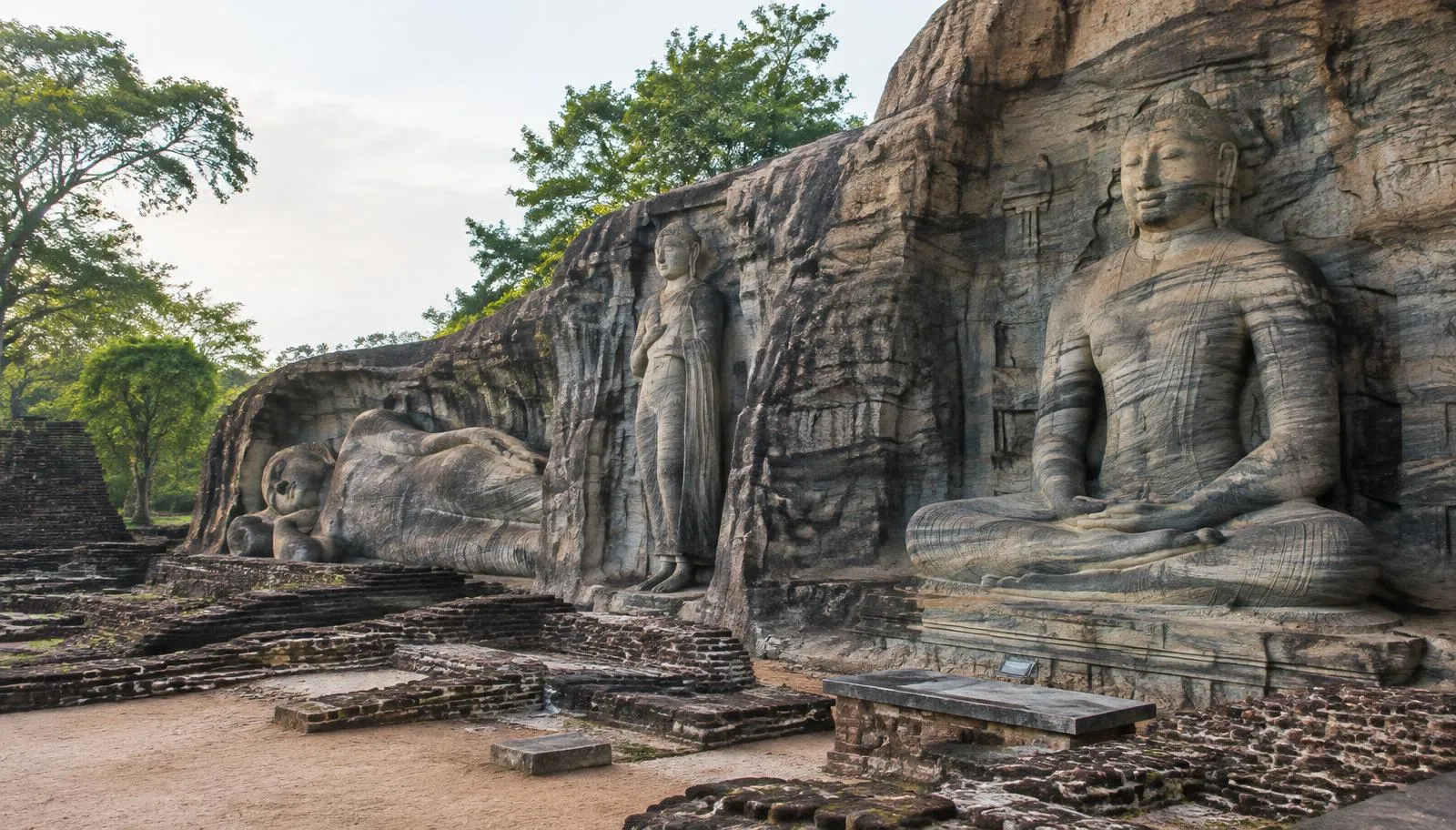
Step 6: The Masterpieces of Gal Vihara No polonnaruwa tour is complete without visiting Uttararama, universally known today as Gal Vihara. Commissioned by King Parakramabahu I, this rock shrine consists of four monumental Buddha images carved directly from a single massive vertical granite boulder, representing the absolute peak of ancient Sinhalese stone sculpture:
- The Seated Buddha: A serene figure depicted in deep meditation (dhyana mudra) upon an ornate throne carved with lions and thunderbolts, framed by a halo of subtle floral relief.
- The Cave Shrine (Vidyadhara Guha): A smaller seated figure housed inside a cave hollowed out of the living rock, flanked by celestial attendants.
- The Standing Buddha: An iconic seven-meter-tall statue standing with crossed arms upon a lotus pedestal, exhibiting an expression of profound compassion that art historians long debated as either the Buddha in meditation or his chief disciple Ananda.
- The Reclining Buddha: A breathtaking 14-meter-long sculpture portraying the Buddha entering Parinirvana (final passing). The subtle indentation of the stone pillow beneath the head and the slightly withdrawn right foot reflect the sculptor's extraordinary sensitivity to anatomical realism.
Step 7: The Outer Shrines and Tivanka Image House For travelers who wish to explore deeper, the northernmost boundary contains the Tivanka Image House, famous for its preserved interior frescoes depicting Jataka tales (previous lives of the Buddha) and the iconic statue depicting the Buddha curved in three places (tivanka pose). Nearby lies the Lotus Pond (Nelum Pokuna), a tiered bath carved out of granite slabs in the shape of a full-blown eight-petaled lotus flower, illustrating the artistic whimsy of royal landscapers.
Step 8: The Parakrama Samudra (Sea of Parakrama) Your day concludes along the vast grassy bund of the Parakrama Samudra. Spanning thousands of hectares, this artificial reservoir unified several smaller ancient tanks to supply water to thousands of acres of paddy fields and cool the palace gardens. Watching the afternoon breeze create ripples on this inland sea while herons and cormorants fish along its shallows offers a peaceful, contemplative finale to your day.
Who It Suits and Safety Considerations
A polonnaruwa ancient city excursion caters wonderfully to a wide spectrum of international travelers:
- Cultural and History Enthusiasts: The depth of historical inscriptions, architectural evolution, and religious art provides endless fascination for scholars and heritage lovers.
- Families with Children: Unlike museums confined to indoor glass cases, Polonnaruwa is an expansive outdoor park where children can walk among ancient palace walls, spot wild birds and playful monkeys, and visualize real-world kingdoms.
- Photographers: From dramatic brick arches and carved moonstones to tranquil water reservoirs and granite masterpieces, the visual diversity is extraordinary.
- Seniors and Leisure Travelers: Because private vehicles are permitted to drive between the main architectural clusters, walking can be easily calibrated to individual stamina levels. You never have to trek exhausting distances under the sun unless you choose to.
Safety inside the archaeological complex is very straightforward. The pathways are largely flat and well-maintained dirt or grass tracks. Visitors should watch their footing on ancient stone steps, which can become slick if damp or uneven from centuries of foot traffic. Wild toque macaques and grey langurs inhabit the forest margins; while entertaining to observe from a distance, they should never be fed, approached, or touched, as they are protective of their troops.
What to Wear and What to Bring
Because the ancient city contains active and consecrated Buddhist shrines, strict temple etiquette must be observed when stepping onto sacred terraces (such as the Quadrangle, Rankoth Vehera, Kiri Vehera, and Gal Vihara). Adhering to these conventions ensures a respectful and hassle-free tour.
Clothing Recommendations - Modest Attire: Shoulders and knees must be fully covered for both men and women. Loose, lightweight cotton or linen trousers, long skirts, and breathable shirts or blouses with sleeves are ideal for the tropical heat. - Footwear: You will need to remove your shoes and hats before entering all sacred stone platforms and temple enclosures. Wear slip-on shoes or sandals that are easy to take on and off repeatedly. - Thick Socks: During sunny hours, the exposed granite flagstones and sandy courtyards can become extremely hot. Carrying a thick pair of dark socks in your pocket or daypack allows you to walk across hot stone terraces comfortably while respecting the shoeless requirement.
Essential Items to Pack - Sun Protection: A wide-brimmed sun hat, high-factor sunscreen, and polarized sunglasses are essential when walking across open lawns. - Hydration: Bring refillable water bottles. Staying properly hydrated in the dry-zone humidity is crucial for maintaining your energy. - Insect Repellent: Useful if exploring shaded jungle pathways around the outer ruins in the early morning or late afternoon. - Umbrella: An umbrella provides portable shade from direct sun and doubles as quick protection against unexpected tropical showers. - Camera or Smartphone: Ensure devices are fully charged to capture the magnificent stone masonry and expansive landscapes.
Responsible and Ethical Tourism
Visiting one of the preeminent UNESCO sites Sri Lanka preserves carries a shared responsibility to protect its delicate archaeological fabric and honor local spiritual traditions.
- Sacred Image Etiquette: Never turn your back to a Buddha statue to take a photo or selfie. Posing with your back facing a sacred image is considered deeply disrespectful in Sri Lankan culture. Always face the statue or pose at an angle alongside it without touching or leaning against the masonry.
- Do Not Climb Ruins: Brick structures and carved balustrades in Polonnaruwa are hundreds of years old. Climbing on walls, resting on ancient altars, or standing on fragile stone inscriptions causes irreversible erosion. Stay strictly on marked visitor paths.
- Wildlife Respect: The archaeological park is home to prominent primate troops, including the endemic toque macaque (studied extensively by primatologists for decades). Never feed the monkeys, avoid carrying exposed plastic food bags, and maintain a calm, respectful distance.
- Waste Management: Polonnaruwa is a designated plastic-conscious heritage zone. Never discard plastic bottles, wrappers, or tissues inside the ruins. Pack out all personal rubbish and dispose of it in designated bins near vehicle parking areas.
Combining with Nearby Sights and Routes
Polonnaruwa's location within the Cultural Triangle makes it remarkably easy to integrate into broader travel itineraries across Sri Lanka:
- Sigiriya Lion Rock Fortress: Many travelers base themselves in Sigiriya or Habarana, exploring the dramatic fifth-century rock citadel in the early morning and visiting Polonnaruwa's royal city in the afternoon.
- Minneriya and Kaudulla National Parks: Located just a 30 to 45-minute drive from Polonnaruwa, these wildlife sanctuaries host the famous seasonal elephant gathering. A morning culture tour in Polonnaruwa followed by an afternoon 4x4 open-jeep safari among wild elephant herds creates an unforgettable full-day itinerary.
- Dambulla Royal Cave Temple: Located about 1.5 hours away, this ancient cave complex filled with Buddhist murals and golden statues pairs seamlessly with Polonnaruwa across a multi-day Cultural Triangle circuit.
- Ritigala Strict Natural Reserve: For those seeking mysterious jungle ruins off the standard tourist trail, the ancient forest monastery of Ritigala lies conveniently between Anuradhapura and Polonnaruwa.
- East Coast Transit: When traveling eastward to the white-sand beaches of Passikudah or Trincomalee, Polonnaruwa serves as the perfect cultural midpoint for breaking up the drive.
How Ashi Travels Facilitates Your Tour
Ashi Travels provides dependable private tourist transport services throughout Sri Lanka, giving you complete freedom to discover Polonnaruwa at your own rhythm without the constraints of rigid bus groups or public transit schedules.
Dedicated Air-Conditioned Vehicles Whether you are a solo traveler, a couple, a family, or an extended group, Ashi Travels supplies comfortable, modern private vehicles—ranging from stylish sedans and spacious family vans to larger mini-coaches. Every vehicle is fully air-conditioned, well-maintained, and prepared for Sri Lanka's tropical climate.
Professional Chauffeur-Guides Your dedicated driver brings valuable local highway experience and welcoming hospitality. Having a private driver means you can leave your luggage, extra clothing, and walking gear securely inside the vehicle while you step out to explore each archaeological cluster. Rather than walking miles between distant sectors under the midday sun, your driver drops you at each monument gate and waits ready to transport you directly to the next sector.
Flexible, Tailored Itineraries Your day belongs entirely to you. If you wish to spend an extra hour studying the detailed stone relief of the Vatadage or pause for an authentic village lunch overlooking the reservoir, your Ashi Travels chauffeur accommodates your pace effortlessly. Your driver can also coordinate timely stops at traditional craft workshops, spice gardens, or scenic viewpoint locations along the route.
Effortless WhatsApp Booking Arranging your private transport is fast, direct, and straightforward. Ashi Travels manages all customer communication exclusively through WhatsApp. You can discuss pickup locations, receive vehicle recommendations, confirm daily schedules, and clarify current site logistics with personalized, friendly support.
Practical Tips for Travelers
To maximize your time inside the historical park, keep these practical considerations in mind:
- Ticket Purchase Timing: Entry tickets must be purchased at the main Central Cultural Fund Archaeological Museum before entering the gated historical zones. Keep your ticket safely on hand throughout the day, as electronic checkpoints verify passes at various monument gateways.
- Navigating Inside the Complex: While some visitors rent bicycles at the entrance, cycling across several kilometers of sandy, sun-drenched pathways in dry-zone humidity can quickly become tiring. Traveling inside the ruins via your private air-conditioned vehicle allows you to cool down between historical sectors, stay fresh, and explore the entire city efficiently.
- Local Dining: Excellent local restaurants and open-air garden buffets operate just outside the archaeological boundary. Savor traditional Sri Lankan curries, fresh lotus root preparations, and cooling king coconut water between morning and afternoon exploration.
- Money and Cash: Keep small local currency notes handy for cold drinks, king coconut vendors, parking amenities, and tips for site staff or shoe minders at temple entrances.